

Working on the Road
Vehicle Crossings
A vehicle crossing is the section of driveway from the front of the property boundary to the roadway.
All vehicle crossings must be approved by Council and inspected by our staff throughout construction. This includes vehicle crossings for new builds, adding a new crossing to an existing site, or rebuilding an existing vehicle crossing.
The difference between urban and rural:
The difference in applications is speed. When evaluating a rural vehicle crossing we must consider the speed zone and the viability of the road users. So, choose urban if the road is more than 60km/h. Rural if not.
Information Required by Council
To avoid delays in processing, please ensure your vehicle crossing design and approval letter are submitted at the same time as your Traffic Management Plan.
Information for applicants
Please allow at least 15 working days for Council to process your application from the date it is submitted.
Stock Crossing & Livestock Movements
If you need to move livestock across roads regularly, here’s what you need to do:
Get a permit
- You must get a Stock/Livestock Crossing Consent from us.
- Your crossings must follow the rules in the consent and the Livestock Movements Bylaw 2025.
- Permits last for five years, with regular audits by Council.
Your responsibilities as a permit holder
- Keep the roads clean: You must prevent livestock from fouling the road. If necessary, have a Council-approved method to clean it up.
- Ensure safety: Make sure your crossings are safe for your staff and the public. This helps avoid accidents and keeps everyone protected.

Overweight Permits
All vehicles that exceed the legal weight limits should have an overweight permit.
- State Highways - to obtain a permit contact the New Zealand Transport Agency (NZTA) Waka Kotahi.
- Local roads - Apply for a permit by emailing LA.OWPermits@beca.com
Traffic Management News and Information
Temporary Traffic Management is the process or method of managing road users including vehicles and pedestrians through, or past an activity on the road reserve safely and with a minimum level of inconvenience. (The road reserve is defined as boundary to boundary).
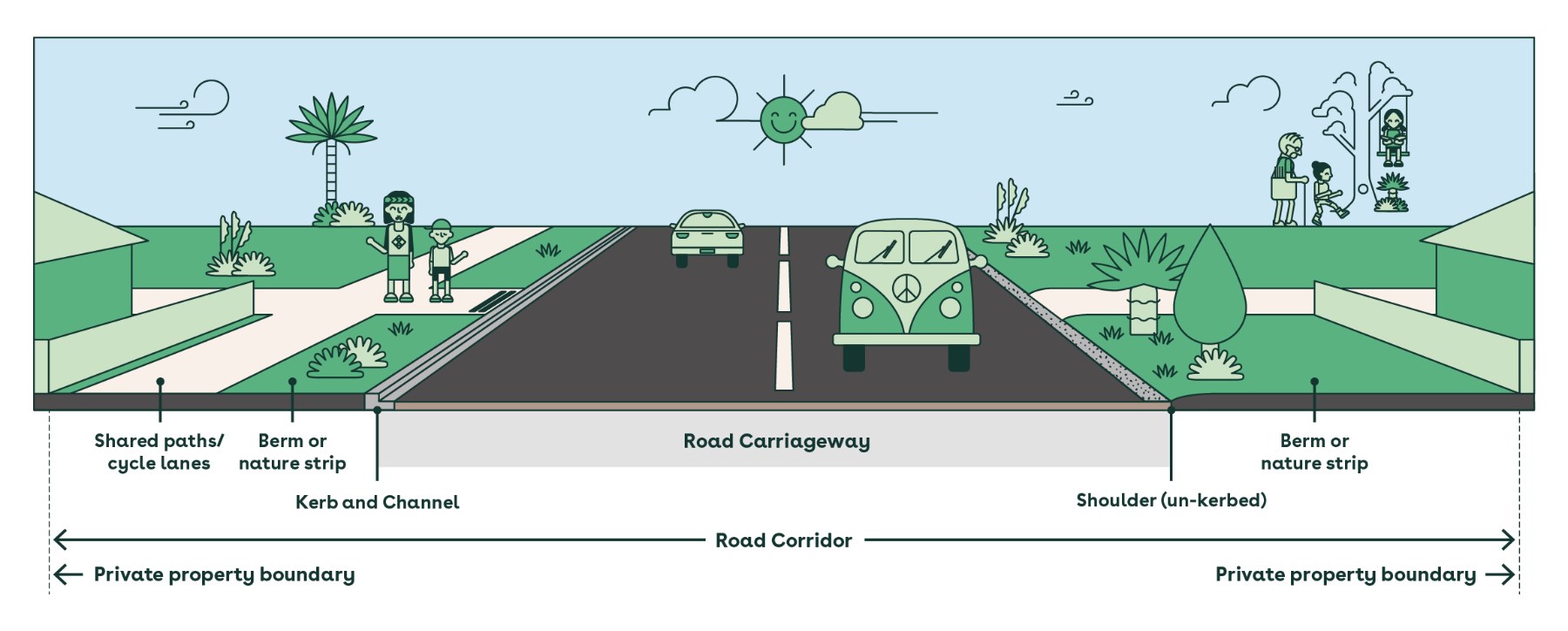
What is a Road Reserve/ Road Corridor?
A road reserve is the area of land between the legal road boundaries. It is often described as extending from fence line to fence line, however, the legal boundaries, not the fence lines, determine its extent.
The road reserve provides space for the carriageway and associated infrastructure, including berms, footpaths, cycle facilities, drainage, signs, streetlights, underground services and, where required, safety run-off areas.
New Zealand Guide to Temporary Traffic Management (NZGTTM)
Western Bay of Plenty District Council have fully transitioned to operating under the principles of the New Zealand Guide to Temporary Traffic Management (NZGTTM). Corridor Access Requests submitted using the principles of the old Code of Practice for Temporary Traffic Management (CoPTTM) will be declined.
Temporary Traffic Management Industry Steering Group
Corridor Access Request
Anyone or any business planning to carry out any work or activity that affects the normal flow or operation of the road, footpath or berm within the road reserve/corridor must apply for a permit known as a Corridor Access Request (CAR), and receive a work access permit (WAP) permitting the activity.
CAR’s ensure that all work is done safely and complies with the national code of practice.
National code of practice
The National Code of Practice for Utility Operators Access to Transport Corridors defines the set of standards for working in the road and the Corridor Access Request (CAR) processes. The Code is mandatory under the Utilities Access Act 2010 and applies to all works carried out in the road corridor, whether the work is for or by a utility, local government, commercial organisation or private individual(s).
A Corridor Access Request is required for, but not limited to, the following activities:
- Trenching works
- Footpaths and entranceways
- Work within the berm or shoulder of the road, and
- Tree work, scaffolding and crane work.
- Any activity that will alter or cause to be altered the surface of any part of the road reserve, including but not limited to excavating, drilling, resurfacing;
- The placement of any pipe, duct, pole, cabinet or other structure below, on or above the road reserve;
- A new/existing vehicle crossing.
Layout diagrams
Layout diagrams are expected as part of the application and must show:
- What signs and other traffic management devices will be used
- Where the various devices (with dimensions) will be set out
- A site drawing that reflects the road layout in the location.
Restricted working hours
The Road Corridor Manager may apply restricted working hours to your works access permit due to the following;
- To avoid peak traffic flows
- To limit interference with property access
- To minimise noise or other environmental impacts
- To allow for school drop off/pick up and foot traffic
How to Apply for a TMP
A Traffic Management Plan must be designed and prepared by a competent person (refer to NZGTTM guidance below)
The person nominated by the contractor in the TMP is to have the specific responsibility for managing all traffic, including cyclists and pedestrians, at the work site. This person must be deemed competent by their employer to undertake the level of temporary traffic management for the road being worked on.
A person wanting to apply for a Corridor Access Request first needs to become a registered user. It is free to register on these websites.
This also provides the mechanism for you to make a Corridor Access Request and provide us with a Traffic Management Plan to protect your site, contractors, and the public during operations.
Submit your TMP online through Submitica
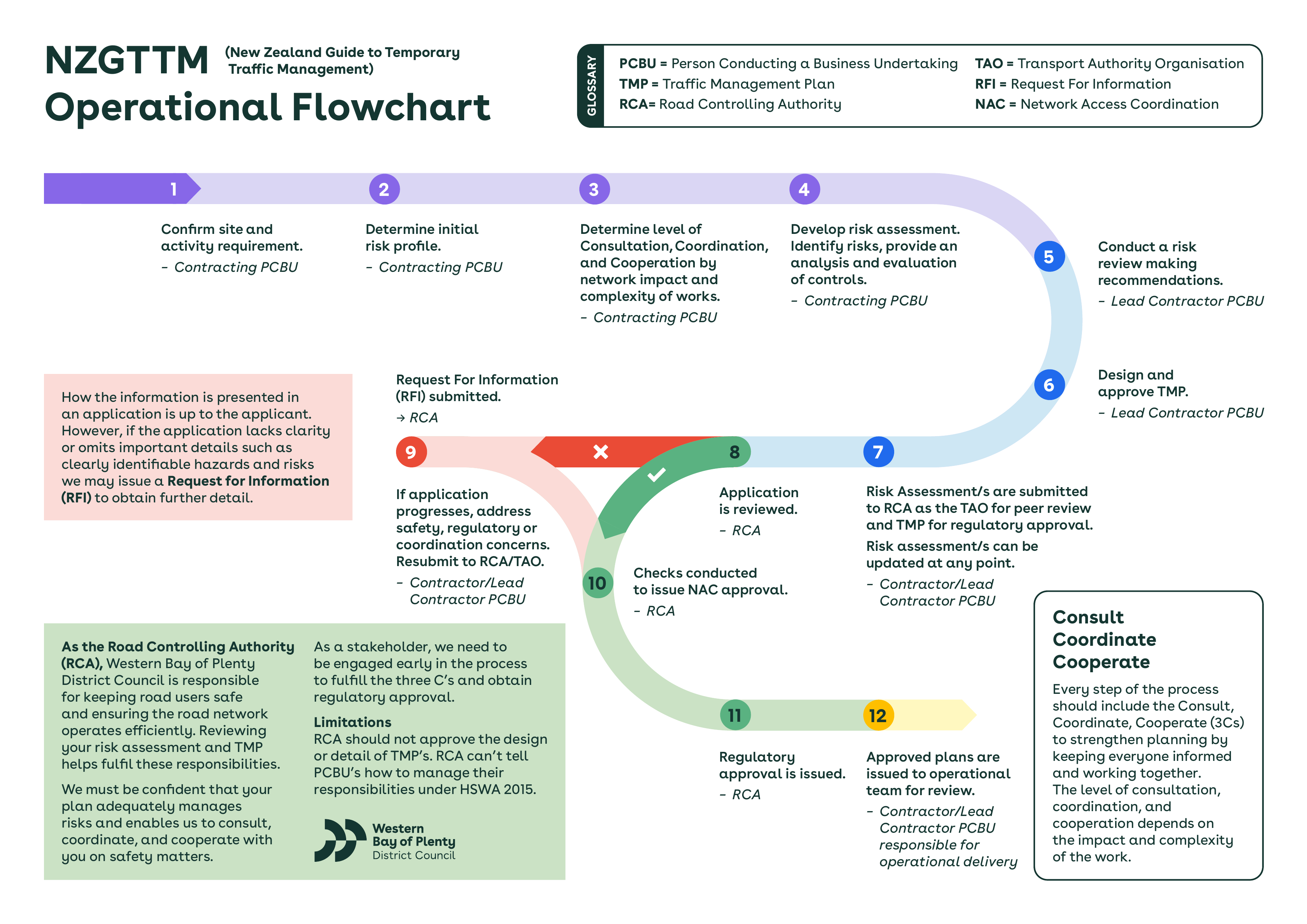
NZGTTM Operational Flowchart
This flowchart shows the steps required to progress temporary traffic management work, from identifying the site risks and preparing the TMP, through Council review and regulatory approval, to operational delivery. It also makes clear who is responsible at each stage and when further information may be required.
Events
If you are planning an event in the Western Bay of Plenty District that may:
- affect vehicle or pedestrian traffic
- increase traffic to a particular area, such as concerts or sporting events
- require a road or footpath closure, such as for parades or marches or
- require temporary road signs.
A Traffic Management Plan may be required. To determine whether traffic management is needed for your event, please contact the Events Team in the first instance.
Traffic management for events
The event facilitation team will liaise with Council's transport team to identify whether there may be a need for traffic management as part of your event planning. If approved, the event organiser will be responsible for engaging a suitably qualified Traffic Management Company and submitting a traffic management plan at least (8) weeks prior to the event.
The Traffic Management Company will prepare a professional Traffic Management Plan on behalf of the event organisers. The plan shall include the location of all relevant structures, equipment, facilities, assembly areas, event or filming areas and other facilities, including (without limitation) signs, cones, marshals, vehicles, parking restrictions, road closure details and access for the mobility impaired, emergency vehicles and to public transport. The plan will also indicate how many qualified STMS, TC, and Marshals will be active within the Road Reserve and their location. We may require further details to be included in any plan. Further details shall be provided as soon as practicable after any such request.
New Zealand Events Association
It is recommended that you use the NZ events Association Practice Note for Planned Public Events to determine what Impact the event might have on the road network. This is just a guideline and it’s still up to the Corridor Team to make the final decision.
NZ Events Association Practice Note
The Impact Classification Tool is a good tool to use when planning an event.
If you’re unsure whether you need a TMP or have any questions, contact us at 07 571 8008 or email TTM@westernbay.govt.nz.


